


First, a confession
I spend most of my days in front of a screen. When I finally climb back out of virtual reality, I like to dig into my book collection. Over the past few years it has grown huge, mostly because I buy books much faster than I find the time to read them. So when I do sit down with one, I usually come out the other side buzzing with excitement and new ideas.
The problem is the little voice in the back of my head. However deep I get into a story, it keeps pulling me back to the work I love and do every day: technology and AI. At some point I stopped fighting it. Now the only way I can make sense of the thoughts that cross over between the two worlds is to put them side by side.
The following is the result of one of those collisions. This time, the book was Hermann Hesse's Siddhartha.
A man who could not be taught
Siddhartha is a short novel about a young man during the time of the Buddha. Its core idea fits in one sentence: you can be taught facts, but wisdom you have to live.
The story is simple. Siddhartha leaves his father's home to find the truth. He meets the Buddha himself and walks away, because he realizes certain lessons cannot be handed over. He gets rich, falls in love, loses himself in money and pleasure, and ends up close to giving up on life. In the end it is a quiet ferryman and a river that teach him to listen and find peace.
Sitting by that river, he has his final realization. Looking into the water, he sees his young self, his lost middle years and his old age all at once, the way the river's source and its mouth exist together in the same flowing water. Time, he understands, is not a line of dominoes where only one falls at a time. It is a vast painting laid out all at once.
The takeaway is that regret for the past and anxiety about the future lose their grip when you realize they are just mental constructs. Everything you were and everything you might become is already part of who you are.
The river and the machine
Why bring up a hundred-year-old novel about spirituality, humanity and purpose in a piece about artificial intelligence? Because the parallels are hard to ignore.
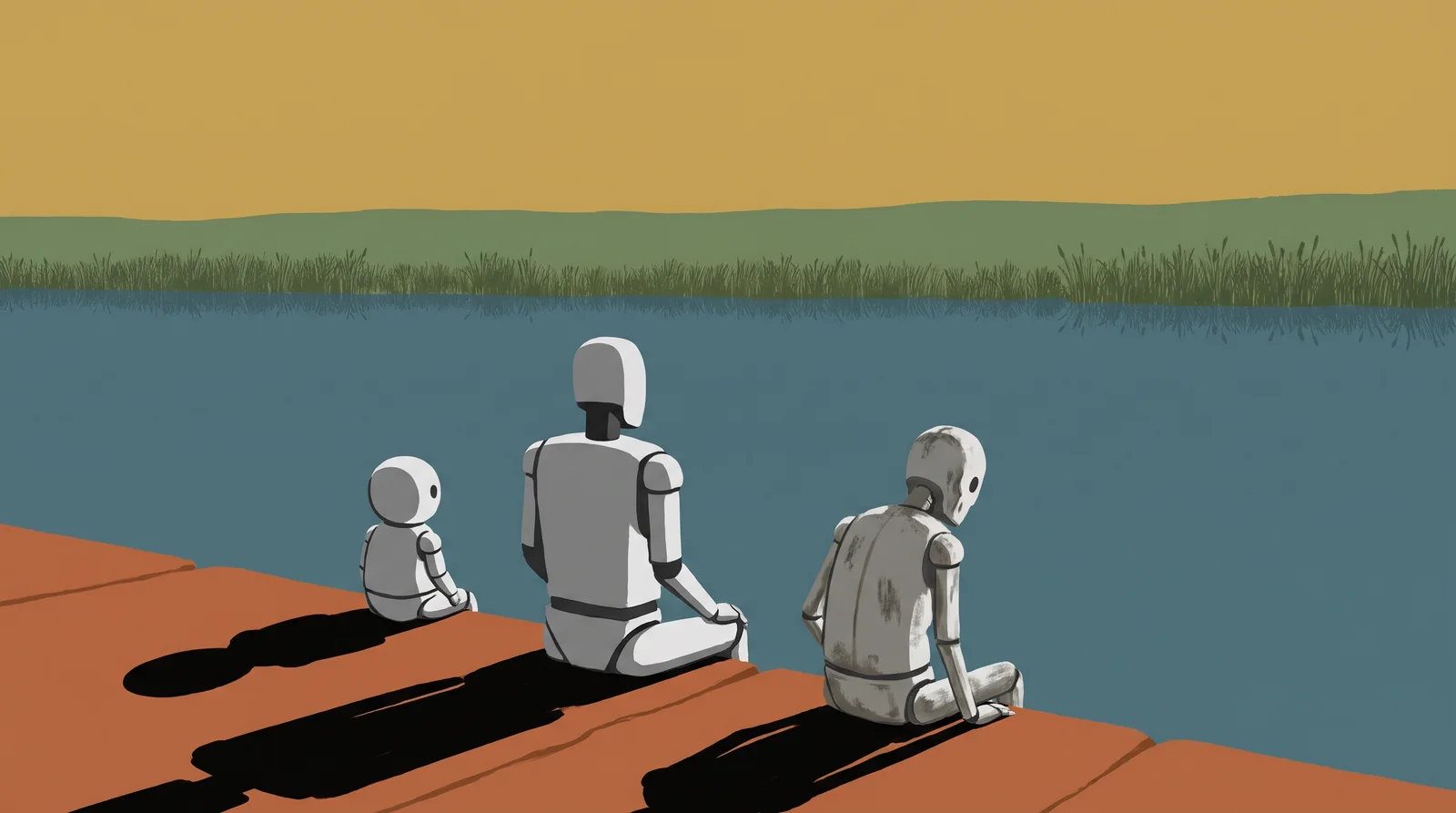
Think of humanity as Siddhartha, and of AI as the river and water we are now looking into. AI is, in a real sense, a compressed archive of human history: it was trained on almost everything we have written, so talking to it means talking to our past. Like Siddhartha at the river, we look in and see all our past selves at once, our poetry and our prejudices, our best ideas and our worst habits.
Our fears about it are built from that same past and projected onto a future that does not exist yet. Our panic about future automation and our baggage from past disruptions are both happening inside our minds, right now.
And underneath all of it sits one important question, one Hesse never had to face: if a machine can retain everything we have ever written, and then start thinking past it, is there anything left that only a human can do? The river has an answer, but it takes the whole journey to hear it.
Our past in the water
Every new technology has had a nervous younger self, and humanity has met each one with a panic of its own.
Socrates warned that writing would ruin human memory. We know this because Plato wrote it down.
When the printing press arrived, authorities feared mass-produced books would corrupt minds with unvetted heresy and falsehoods. The elites focused on losing their role as gatekeepers rather than on the spread of knowledge. Mass printing went on to fuel the Enlightenment, the scientific method and widespread literacy. A few centuries later, people worried that photography would kill painting. Painters are still here.
With factory automation, people panicked that machines would permanently strand the entire working class in joblessness. Many assumed the total amount of work was fixed, so every job a machine took was gone for good. Instead, as routine physical tasks were automated, new kinds of work appeared in service, creative and technical fields. Some workers never recovered. But their children did.
The dot-com bubble shows the opposite mistake. In the late 1990s, investors did not fear the internet; they could not stop buying it. Pets.com went public in early 2000, spent a fortune on a sock-puppet mascot, and shut down nine months later. The hype died. The fiber-optic cables and web protocols built during that frenzy stayed, and became the internet you are using today.
Each time, we expected simple destruction, and each time we got something messier: adaptation, real losses along the way, and a little embarrassment. Seen as part of the river, these panics were stages we passed through. Many of today's fears about AI are the same old fears, back again in a new digital mask.
The mirror
When you prompt an AI, you are looking into a digital mirror that reflects the arc of human thought, from our poetry to our prejudices. Because models are trained on our collective output, talking to them shows us the recurring loops of human ambition, blind spots and error.
That may be exactly why they scare us. What we are facing is not an alien intelligence, but our own past, talking back. The anxieties AI triggers (fear of replacement, loss of meaning, misuse of power) are reflections of our own unresolved tendencies, magnified back at us by a machine that has no moral compass of its own.
Siddhartha could look at his past selves in the water and accept them. We look at ours, reflected through a machine, and mostly feel unease.
Beyond the mirror
So the machine is only us, our past in a mirror. That would be comforting, if it were still entirely true.
Even the newest models built by labs like OpenAI or Anthropic still rely on human writing as their foundation. But they no longer only reflect it. They can find mathematical proofs and strategies that appear in no book they were trained on. A handful of ideas explain how, and all of them are easier to understand if you picture training a puppy.
Reinforcement learning is teaching a computer through trial and error. The puppy gets a treat for a good move and a "no" for a bad one, and repeats until it masters the trick. Unlike a puppy, the computer never gets bored.
Optimization is the computer constantly adjusting its internal settings to make fewer mistakes. Think of the puppy getting a little closer to a perfect "sit" with every try, until it lands it without thinking.
Synthetic generation means the AI invents brand new practice problems for itself instead of only studying old human examples. Picture a puppy that, after learning to fetch a ball, starts making up its own games with sticks and socks to practice.
Test-time compute means that instead of blurting out the first answer, the AI pauses to think through several options and check its work. It is the difference between a puppy that leaps at the first thing you say and one that waits a second to hear whether you said "sit" or "stay."
Scale is doing all of this millions of times across huge computer clusters. Imagine a million puppies practicing at the same time and instantly sharing every trick any of them learns.
Put these together, and the AI stops being only a copy of our past writing and starts finding new answers, though always inside the rules we gave it.
Who checks an answer no one has seen before?
If an AI invents a practice problem that has never existed, how does anyone know its answer is right? It does not just guess. It relies on built-in "rules of reality," automated checkers that act as strict judges. For math, the computer checks whether the equation actually works out. For code, it runs the program in a safe test space to see if it works without crashing.
So what if a model contradicts mathematics or logic? Usually, that means the model made a mistake, not that the laws of the universe changed. A chess computer might invent a bizarre strategy that baffles grandmasters, but it never breaks the rules of the game. Then again, chess is the easy case: we wrote its rules ourselves, so we know they are complete. The rules of reality we did not write. We only worked them out, with our own eyes and our own heads.
But what if our logic is limited by our own senses? It has happened before. For centuries, the geometry of Euclid and the physics of Newton were treated as absolute laws of reality because they matched every human experience. When scientists discovered that space curves and that particles can be in several states at once, they did not throw logic away. They expanded it to cover things our senses could never perceive directly.
There is no reason to think we are done. Our logic probably still has holes we cannot see, and that creates an awkward problem: the first sign of such a hole might look exactly like a mistake. Our checkers would mark the answer wrong, and we would throw it away. The machine cannot settle it either. It was built on the same logic it would need to question, a bit like checking a ruler with the same ruler. So when an AI produces something that looks wrong, the honest answer is that it usually is wrong, and once in a while it might be pointing at a blind spot in us.
That is where AI can help, as long as we keep looking at its strange answers. It can combine old ideas in ways our brains are too slow to manage and turn up patterns that do not fit. It has no outside anchor to reality, so it cannot prove it has found a higher truth. It can only show where our maps stop matching the territory. Humans have to do the rest: question the old rules, test the strange result, and sometimes rewrite our theories around it. The new rules then become the next starting point, and the loop begins again.
Looking downstream
So far we have looked upstream, at the past. Now turn around and look downstream, at the future. Terminator-style robots coming for us? A superintelligence deciding humans are inefficient and not required? Systems run by AI that we no longer understand?
Strip away the movie posters and almost every one of these fears is about losing control of something we built.
What the fears are really about
Underneath the sci-fi scenarios lie much older insecurities: the fear of being pushed aside by a superior force, the shock of watching skill and intellect lose their economic worth, and the unsettling thought of no longer being the smartest thing on the planet.
Just as Siddhartha's early suffering came from ego and attachment, our collective panic over AI works like an ego-driven defense mechanism. When we fear machines taking over, we are often projecting our anxiety about our own powerlessness, and a dread that our existence might turn out to be insignificant.
That does not make every fear foolish. Some are not really fears at all, but real problems to solve: the economic displacement of workers, the concentration of power in a few companies, bias in automated decisions, and the erosion of shared truth through deepfakes and synthetic media. Others are mostly ego: the total loss of human uniqueness, the cosmic irrelevance of human consciousness, and machines feeling spite or malice toward us.
It is much easier to panic about a cinematic villain than to confront the ordinary, human-made unfairness happening right now. Imagining that machines will despise us protects us from looking at how we already undervalue human labor and connection in some of our own economic systems.
Our worth does not depend on being the fastest calculator in the room. We lost that title to the pocket calculator fifty years ago, and still, nobody I know mourns dividing decimals with a pencil.
That frees our energy for practical guardrails: regulating algorithmic bias, enforcing data privacy laws, and releasing new tools safely. Instead of arguing about whether an algorithm has a soul or a vendetta, we can focus on concrete policies, laws and technical safeguards. And responsibility goes back where it belongs: to the developers and companies building the tools.
Old biases, new speed
Bias is the clearest example of a real problem, so it is worth taking a closer look at.
AI models learn from patterns in historical human data. Imagine a bank that, for decades, gave fewer loans to people from certain neighborhoods or backgrounds. A model trained on those records does not see that as unfair. It sees it as a pattern, and learns the rule "people like this get fewer loans." Then it applies that rule to new applicants who share the same traits. The computer holds no personal prejudice; it simply copies the past and automates it, locking old unfairness into a neat digital formula.
It can also make things worse. A model compresses everything it learned into patterns, and patterns can exaggerate. A link that was weak in the real data can come out stronger in the model's answers, and a model can invent confident claims that were never true. So AI does not only inherit our biases; it can distort and amplify them. There may also be a deeper limit: squeezing the near-infinite complexity of human behavior and relationships into patterns may simply never be good enough. We are selfish, unpredictable and completely chaotic beings.
The big labs do work on this. Before training, they clean and rebalance their data to remove openly hateful or skewed material. After training, they use human feedback to penalize biased or discriminatory answers. That catches the obvious cases. The subtle ones are harder, because the training data, the huge mass of human writing on the internet, is shaped by past inequality. In 2023, Anthropic published a study that tested its own model on made-up decisions such as approving loans or housing applications, and found measurable differences in how it treated people depending on their demographics. Careful instructions reduced those differences sharply, which shows the problem can be worked on, and also that it is there to begin with. Cleaning the data alone cannot remove history.
Here the river story turns. Siddhartha learned to hold his past without being ruled by it. The machine holds the same past and cannot let go; it repeats what it has seen. Any freedom from that past has to come from us.
The water changes, the river stays
If the real risks are human, so is the resilience. Most past panics faded because people adapted.
Science explains that through neuroplasticity: the brain rewiring itself as we live and learn. That is how we got through stone tools, the printing press and the factory, and it is how we will get through this. Spiritual traditions like the one in Hesse's story add one thing: underneath all types of change, something in us stays constant, an awareness that watches everything else evolve.
The water is never the same water, but the river is always the river.
What a machine cannot live through
Which brings us back to the question from the start: can a machine ever truly be like us?
It depends on what you think a mind is. In one view, the mind is a pattern of information, so if a system processes information, models the world and shows self-awareness in a complex enough way, it is conscious in practice, whether it runs on carbon or silicon. In the other view, consciousness is a lived quality: the actual feeling of the river flowing. A machine can perfectly copy the outward signs of understanding, but a simulation of fire does not burn.
The second view points to feeling. Our emotions are chemical states designed to manage a fragile, mortal body. A machine does not fear death, hunger or injury, so even if it calculates a picture of sadness, nothing is at stake for it. On this view, a computer cannot truly suffer either, because suffering is an alarm system for physical survival. Pain is a signal that says, "Your tissue is damaged; fix it or you will die." Without a body that can break, bleed, starve or die, a machine can say "I am hurting" without anything behind the words.
That would mean our value does not come from efficient calculation. It comes from our vulnerability, and from our capacity to suffer, care and find meaning precisely because our time is limited.
Siddhartha found peace through hunger, pleasure and grief. Every lesson that got him there was learned in a body that lived through it.
What if we stopped aging?
Let's take a little detour. If our meaning comes from limited time, what happens if we build the technology to stop or reverse aging?
If aging is conquered and human time becomes practically endless, the ground human meaning stands on would shift. Our capacity to feel urgency, appreciate experiences and value our choices relies heavily on the boundary of death. Without it, the stakes that drive our emotions and attachments would radically change. Infinite time sounds wonderful, until you remember what you did with your last free Sunday.
It would not make us obsolete, though. Freed from the constant work of protecting a fragile body, we would have to find motivation beyond survival. In a strange way, it is what Siddhartha reached by the river: freedom from the constant pressure of a ticking clock, without actually dying. He got there by understanding, not by technology, and that may be the only way to get there at all.
What if we give the machine a body?
Back to the main current, with a twist. Does anything change if we give the machine a body?
This is already happening in labs, in a field called biocomputing. Instead of simulating a brain with math on a silicon chip, researchers grow real human or animal brain cells directly onto chips that can read and stimulate their electrical activity. The chip sends the cells reward or penalty signals, and the neurons physically rewire their connections to do better. In Cortical Labs' DishBrain experiment, a dish of hundreds of thousands of living neurons learned to play a simple game of Pong within minutes, just by reacting to electrical feedback.
That crosses the border from pure software into living tissue, and it raises hard ethical questions. When a computer is literally powered by living neurons that adapt and reorganize themselves, it stops being just a tool and becomes a biological hybrid. And the clean line between "body" and "machine" starts to blur.
The answer: nobody knows yet
So can we say for certain that our essence can never be copied? Honestly, that's tricky.
The main counterargument is a theory called substrate independence. It says consciousness is like software: it does not care whether it runs on an organic brain or a computer chip, as long as the program is complex enough. If that is right, our chemical emotions and fragile bodies are just the hardware evolution happened to give us, not the only way to feel.
Experts split along their own backgrounds. People from AI engineering tend to see the brain as an advanced biological computer, which makes a machine mind an engineering challenge. People from the life sciences tend to see consciousness as inseparable from a living body fighting to stay alive. Since science still has no theory of how matter turns into feeling, each side fills the missing piece with its own field.
Until that piece is found, saying humans can never be copied is an educated guess, not a proven law.
Back to the river
Put the story and the machine side by side and the parallels line up. Siddhartha's past selves live in the river; humanity's past, its poetry and its prejudices, lives inside the models we have built. Siddhartha's younger self feared losing himself; humanity's younger self feared writing, the press and the factory, and each time it expected destruction and got adaptation. Siddhartha's suffering came from ego and attachment; our loudest fears about AI come from the same place, and they distract us from the quieter, human-made problems we could actually fix. No teacher could hand Siddhartha enlightenment; a machine can hold all of human knowledge and still cannot do our understanding for us. And whether a machine can ever feel anything at all remains an open question.
What the story offers, in the end, is a way of thinking rather than a prediction. Much of our regret and worry lives only in our heads. But not everything we feel about AI is a construct. Some of it is a real problem: jobs changing faster than safety nets, power gathering in a few hands, old biases running at new speed. Those are not fears to let go of. They are problems to solve, and the only place to solve them is right here in the present.
So stop treating AI's path as a terrifying destiny arriving tomorrow. Use the tools as they are today, firsthand, and judge them by what they actually do. Put your ethical choices into the current prompt, the current line of code, the current collaboration. Build guardrails against the harms that are real, and let the grand dramas go. And keep for yourself the part no machine can carry for you: living through things, which is where wisdom comes from.