


It starts in the sky.
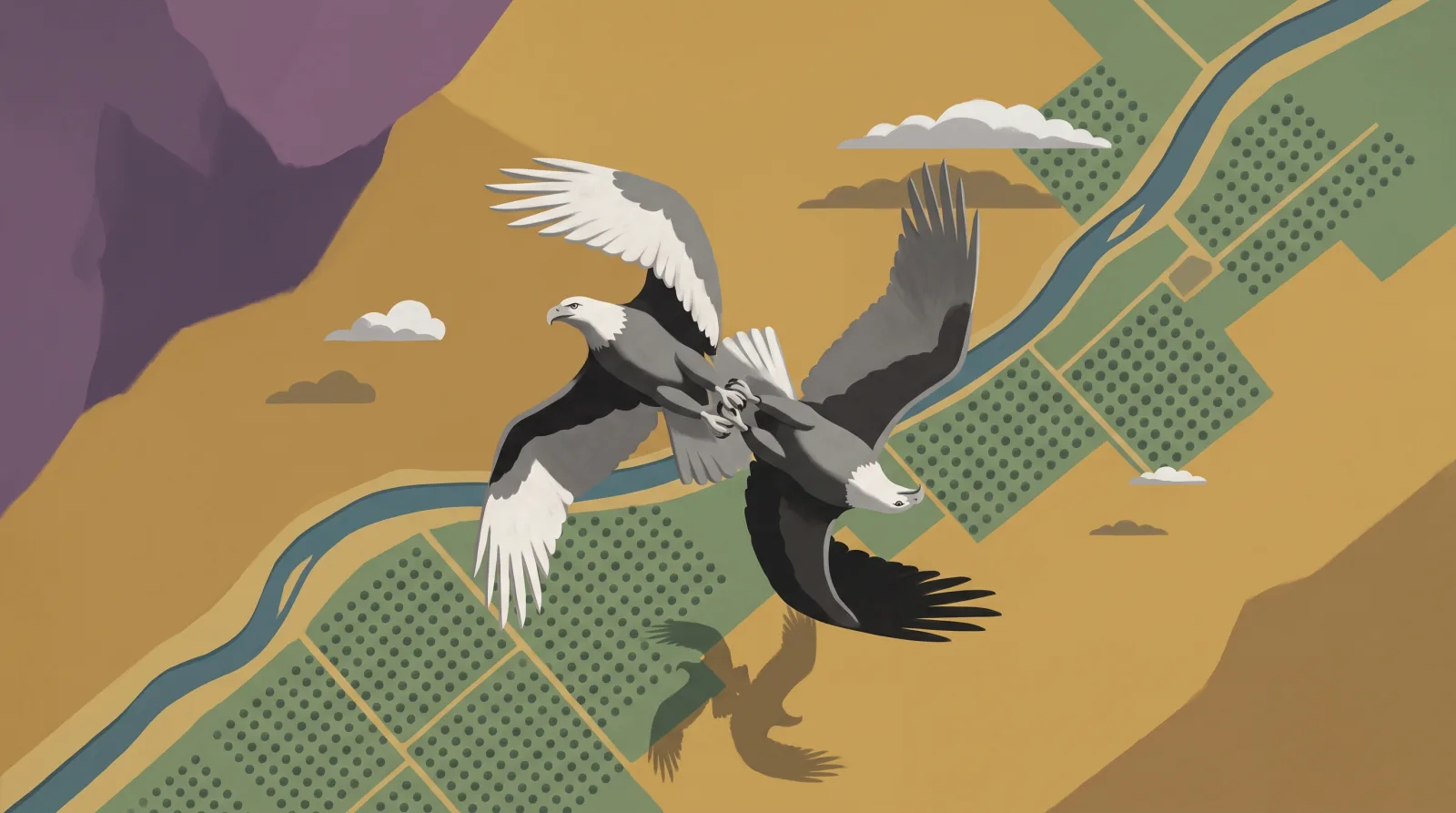
Two bald eagles meet somewhere above a river bend. The larger one drops from a thermal, a column of warm rising air. The other one rises. For a moment they are parallel in the sky, wings spread, talons forward. Then they touch.
What happens next has kept ornithologists, the scientists who study birds, debating forever. The two birds lock feet, tuck wings, and fall. They spin on the way down, a wheel turning against the sky. People who see it from a trail sometimes freeze, sometimes shout. Ornithologists call it the cartwheel display. Most everyone else calls it the death spiral, which captures the feeling, and one of the possible outcomes.
Usually they release before they reach the trees. Sometimes neither bird does.
The poet Walt Whitman encountered this scene through his friend John Burroughs's written account. Burroughs recorded the display in his 1878 journal. Whitman read it and turned it into a poem two years later. In "The Dalliance of the Eagles," he describes "a motionless still balance in the air" in the moment just before the birds part. What intrigues me is not the fall itself. It's that short moment of tension before letting go, when both birds are still holding and the ground is getting closer.
Holding costs nothing. Opening takes will.
Birders find this part extraordinary: holding the grip costs nearly no energy. Eagle feet have a tendon ratchet, a passive lock that keeps the talons clenched with minimal muscular effort. Perching through a cold night, riding a thermal for an hour, holding another bird in a spin toward the ground: all of it happens at low energy expenditure. The talon holds by default. But the grip is never involuntary.
Opening the grip is what takes effort. Opening requires will.
The same behavior appears in courtship and in territorial combat, and observers on the ground cannot always tell which is happening. Love and contest, wearing identical form. What matters, in both cases, is that at some point one bird decides to release, the other follows, and they each find air again.
There are documented cases where the release didn't happen. Eagles found on riverbanks, talons still locked, neither bird having opened its grip in time. The water nearby, the wings still spread.
These cases are rare. But they exist, which suggests that the simple version of the story, the one where the grip is involuntary, is unlikely. The grip is always a choice.
Your skills have a tendon ratchet too
I think about this when I talk to people who have learned something the hard way.
After spending years becoming good at your job, you know the seventeen substeps of a specific workflow because you ran them two hundred times before any technology existed to shortcut them. The knowledge lives in sequence, in a mental model built from repetition and from the corrections that repetition forces. You can feel the difference between a good answer and a bad one without fully explaining how. That intuition is real, and it was worth the pain it took to build.
What becomes trickier to see is whether those reps and steps still matter.
The gap between wanting to do something and being able to do it has collapsed. Writing a first draft, building a working prototype, generating a legal summary, translating a document with the right tone: that gap has almost closed. You no longer really need the prerequisite to get the result.
This is unsettling. It feels like the loss of a floor, not a ceiling. The hard thing you built to get here: what is it worth now? It's an uncomfortable question to answer.
The ratchet holds without effort in one direction; opening requires active effort. The longer the spiral continues past its natural end, the more the holding costs. It isn't because holding is wrong, but because the fall is happening regardless, and the grip is no longer doing the work it was built to do.
AI deletes the prerequisite, not you
A junior analyst who once spent three weeks hand-building a financial model from scratch now scaffolds the same thing in twenty minutes. Nevertheless, the three weeks still matter. The judgment about which assumptions are wrong, which outputs don't smell right, which conclusions the model can't actually support: those came from the three weeks. That analyst knows the places where the tool generates plausible-looking numbers that are actually nonsense. That knowledge is not in the tool, and twenty minutes of scaffolding didn't build it.
The same principle applies to technological progress. AI doesn't replace you. It deletes the prerequisite. What's left is your judgment.
You are the one who knows when the output is wrong. You set the brief, read the result, feel the distance between what output got generated and what you meant. That capacity came from the repetitions, from the corrections, from learning what bad looks like so you could recognize good. What technology removed was the production layer.
Separate again and moving
Whitman's poem ends with the birds parting, each continuing into its own sky. Not diminished, and not fused, but separate again and moving.
We are still in the first days of this change, and the habits it disrupts are fresh enough to sting. Most of the resistance I hear really is about identity: if I no longer do this part, what am I? That's a fair question. The answer is that you are the judgment, the accountability, the direction. You are whoever was doing the taste-testing before the prerequisite cleared away.
None of that lives in the ratchet. All of it lives in the choice to open.