



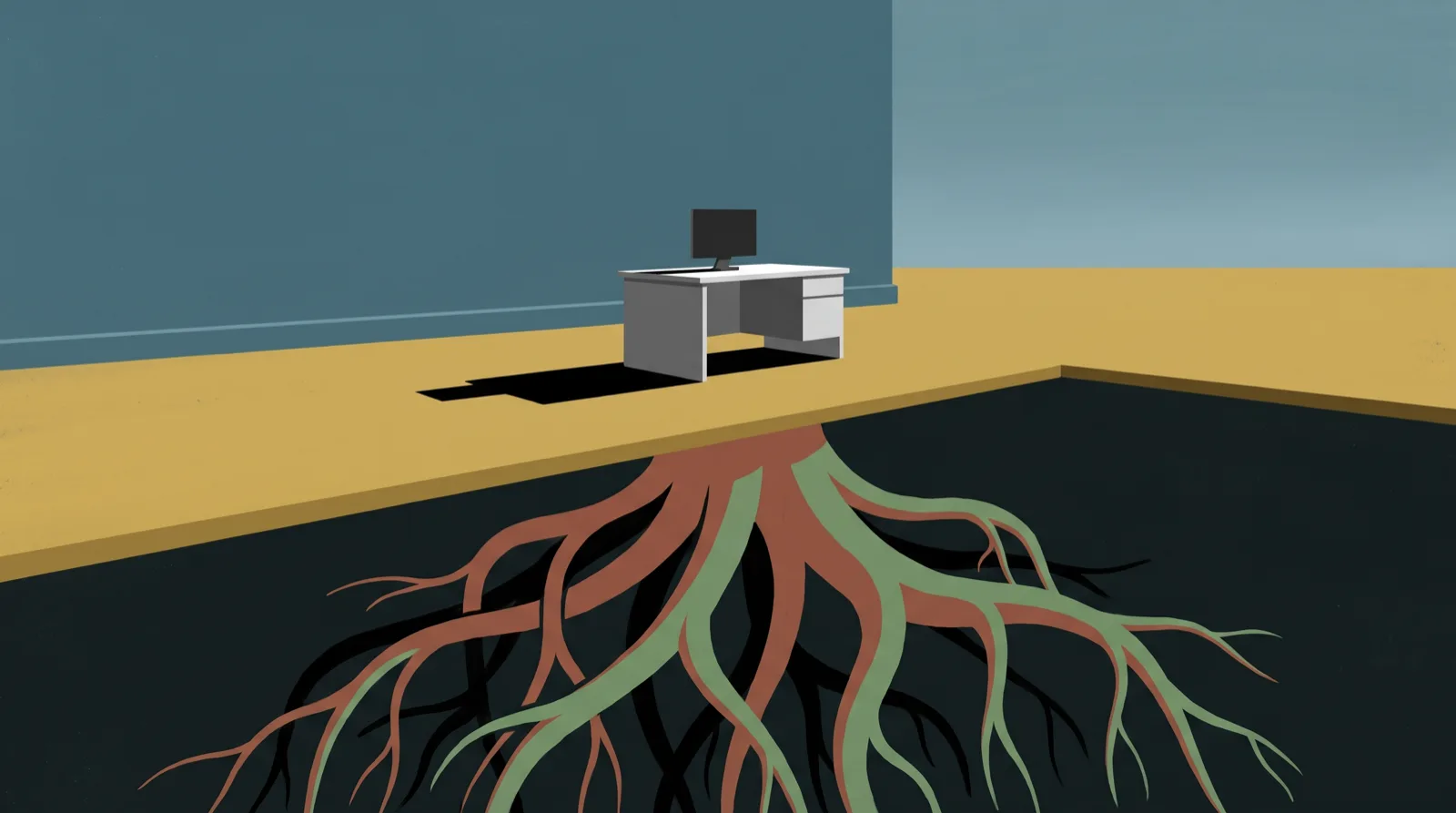

Root First
Recently the days have been long and the output immense. Most of my time is spent directing and monitoring several threads of work done by AI agents, running in agentic coding tools that operate out of my computer terminal. Put simply, my job is pointing agents, which we could describe as digital workers, at the right problems and holding the top-level view while the execution of most tasks gets done for me. By evening I have finished what would have taken me four or five days a few years ago.
Reflecting on such days I get this feeling that something doesn't add up. I've been very productive, but it doesn't feel like I've created much. I miss the satisfaction of taking on a task and finishing it end to end, even a task AI would now do in minutes. My own thinking touched only parts of the output, so a question sits underneath the whole day: was it actually me and my brain who did the work?
I would not trade this way of working back. The way I get satisfaction has changed, that's all. It now comes from stepping back at the end of the day, seeing everything that got done, and feeling the whole company move at a speed that would have been impossible just months ago. That part really feels close to magical.
But the feeling points at something weird. When the thinking gets offloaded, something is being borrowed, and I wanted to know what, and from whom. Is it my own attention? The judgment I would have built by doing it myself? The memory of having done it at all? The clearest answer I found starts in an unexpected place: botany.
Consider the way in which a plant grows. It starts with a seed in the dark that has two tasks and they go in strict order: root first, shoot second. The root goes down. The shoot goes up. Before a single leaf can reach sunlight, something invisible has to happen below the surface.
A plant senses light through photoreceptor cells and bends its growing tip toward the source. This is referred to as phototropism: the tendency of a growing shoot to orient toward light. A shoot that bends toward light also needs to know which direction is down. That is gravitropism: the capacity of plant tissue to sense gravity and use it as a directional signal. The root grows toward gravity. The shoot grows against it.
The shoot has a growth chemical inside it. When light comes from one side, the chemical moves to the dark side. The cells on the dark side grow longer. The cells on the light side stay short. So the tip bends toward the light.
Gravity works with an even simpler trick. Some cells hold tiny heavy grains. The grains sink to the bottom of the cell, like sand in a glass of water. Tilt the plant and the grains slide to a new spot. The plant feels where the grains are and grows the other way. The root follows the grains downward and the shoot grows up, away from them.
These are just small, local, chemical responses to physical pressure, and yet it is a biologically codified sequence: root first, then shoot, in that order, every time.
Useful Friction
The invisible half of something that slowly materializes is normally built first. It's like getting fit: the months of training nobody sees come before the physical changes to your body that everyone notices. It is built by pushing against resistance.
The root doesn't anchor because the soil is soft. On the contrary, it anchors because the soil pushes back. Without that resistance there is nothing to grip. The shoot can rise only as high as the roots can provide stability.
The same logic runs through physics. Newton's third law says that every force meets an equal and opposite one. When your foot presses the ground, the ground presses back with identical force, and that push-back is what actually moves you forward. Without something solid underfoot, the effort is meaningless. You can feel this principle without knowing the equations: effort that meets real resistance leaves something behind, a structure that holds, a gain, or a mark, like the calluses on a climber's hands. Effort that meets nothingness becomes undirected motion.
Think of a frozen lake. In sneakers, you push off and your foot slides back. You go nowhere. On skates, the thin blade cuts a little into the ice. Now you have something to push against, and you glide. The smooth ice alone doesn't give you anything, it's the small bit of resistance the blade creates that makes you fast.
Delayed Gratification
There is a name for the choice to keep friction on purpose.
Delayed gratification is the decision to trade something available now for something better later. It is voluntary resistance. You feel the discomfort it creates, and you let it stay and accept it, because you have enough trust in what is coming to believe the wait is worth it.
In the late 1960s, researcher Walter Mischel ran a series of experiments at Stanford that would become famous as the marshmallow test. Children sat alone with a single marshmallow in front of them. They were told they could eat it now, or wait, and if they waited, they would get two marshmallows when the researcher returned. Some children waited. Some did not. Later tracking suggested that the children who waited did better across a range of outcomes, from academic performance to health measures, years later.
Then researchers looked again. In 2018, Tyler Watts and his colleagues ran a larger, more carefully controlled replication. Once they accounted for a child's family income and home stability, the predictive power of waiting mostly disappeared. The children who grabbed the marshmallow were not less disciplined, but could actually be considered more rational. If you grow up where promises get broken and the researcher might not come back, taking the guaranteed option is a sensible calculation.
This leads to the thesis that patience is not only a character trait. It is a bet on trustworthy soil.
A root will not invest downward into poisoned ground. If the earth does not hold, extension is waste. The root knows this. So does the child who grabs what is certain while it is certain.
Hidden Symmetry
At this point you may start to see three things that look entirely unrelated grow the same way.
The plant adjusts cell by cell as the light moves. You have done the same thing every time you learned a skill the hard way. Think of learning to ride a bike: you wobble, you fall, you adjust, and one day it just clicks and works. During training, a large language model learns the same way. It guesses the next word, gets it wrong, and nudges its internal settings to shrink the error, millions of times, before anything useful comes out.
Here's the shared approach: small corrections against resistance, a foundation laid slowly before any reliable output appears. That seems to be how anything durable gets built from the bottom up.
Modern Temptation
For the first time, we have created something that removes the human effort entirely.
Artificial intelligence.
That is what makes this moment different from every previous acceleration. Every other invention in history accelerated one side of the work or the other: faster machines, faster communication, faster computation. The resistance was still there and you had to think, fail, and build the root mass yourself.
Now you can outsource the appearance of having done that work, and it's almost impossible to tell from the outside that you didn't.
Most people aim AI upwards. They focus on more output and more speed. The shoot grows fast and the fruit appears quickly. Yet in this case, the roots stay exactly where they were, and the growth is only superficial.
I call this borrowed sunlight. It is energy that produces visible growth without the underground work that would make that growth stable. For a little while it looks like progress and feels like productivity, until weight is applied. Until a real decision has to be made with genuine understanding behind it, until the market turns, until a competitor forces you back to first principles, the basic facts underneath everything. Then the shallow root system shows itself, and the debt that was accumulating invisibly becomes visible all at once.
Remember the child and the marshmallow. Waiting only makes sense when the soil can be trusted. The same test applies here, turned the other way. AI offers to do the hard part for you. Before you say yes, ask what the hard part was doing for you.
Sometimes the friction you felt was holding everything up, and removing it is like tearing down a wall because it is in your way, then finding out it was carrying the roof. Identifying if a wall can be torn down without destabilizing the entire building requires all of your critical judgment and expertise.
What Depth Costs
I think of depth as a deliberate drag, like training with a weighted vest. Imagine a team that forces itself to slow down and takes a hard look at the assumptions before they get built into something expensive to undo later. The drag is what creates something stable that holds, instead of something fast and hollow.
People who study how complex systems fail have long made a version of this argument. A system left to its own amplifying feedback will take a small flaw in its foundation and scale it into a large one. It needs something that pushes back, catches a small mistake early, and forces a fix. Without that resistance, the error doesn't stay small and the collapse happens as soon as there is enough scale to make it visible.
All of this comes down to what you choose to measure: the visible output, or the hidden foundation. Let's call them fruit metrics and root mass.
Fruit metrics are the numbers you can read at harvest: hours saved, output volume, revenue generated, speed of delivery. They are real and they matter. A business that ignores them does not stay a business for long. But they are lagging. You only see them after the work has been done, and chasing them rewards every shortcut that feels like productivity while skipping the knowledge that would build real compounding value and make the next cycle faster, not just this one.
Root mass is different. Root mass is the unglamorous work of encoding what you know into the structure itself, into the models, the processes, the institutional memory, the shared understanding of why decisions get made the way they do. Future output compounds from root mass without you having to be there. It is the only kind of productivity that does not reset to zero when you stop pushing.
Human systems follow the same logic. An organization's real roots are its unseen norms: the questions people feel safe asking, the information that actually flows upward, the incentives that shape the thousand small choices that are made daily when nobody is watching. A company that builds fast above the ground while skipping that work is a tree with shallow roots. It looks healthy until a real storm arrives.
And then there is the outsourcing question. Outsourcing your core work while skipping the foundational strain is like eating fruit from the tree next door instead of growing your own roots and trees. It feeds you today. But you never met the resistance, and you grow no root system of your own.
When the season turns, when the neighbor's tree is gone or the terms change, you cannot feed yourself, because you never paid the underground cost that would have made you capable of it. Building in-house means accepting the strain now to own the structure later. The strain is what grows the root.
Harvest and the Choice
The point of roots is fruit. I know that. I am not praising struggle for its own sake. Friction is not the goal. It is the price of something that lasts.
When you harvest from a deeply rooted tree, the tree does not die. The fruit falls, the nutrients cycle back into the soil, the tree stands through the winter, and it does it again the following season from a root system that went a little deeper than the year before. That is compounding. The tree isn't depleted by its output, and harvest and growth can happen in the same cycle.
Taking everything from the soil and giving nothing back looks identical for one season. Same fruit, same yield. You would not know the difference from the outside, as the distinction is entirely underground.
We have a technology now strong enough to do either. It can dig. Aimed down, it builds root mass, encodes genuine understanding into structure, accelerates the foundational work that used to take years of slow error and correction. It takes hard-won judgment and compounds it, makes the root system more transferable, more durable.
Or it can skim. It can produce the appearance of fruit from soil that was never truly cultivated.
The choice is a structural one. Aim AI upward and we grow taller and more hollow. Aim it downward and we build the foundation faster, and with a better instrument than anyone has ever had before.
A seed in the dark doesn't have this choice. It sends the root down first because the chemistry demands it, because the grains settle, the growth chemical moves, and the cells on one side grow longer, and there is no other way for a seed to become a tree. That is a fixed sequence, dictated by nature. It's the condition of becoming a tree at all.
We can now override the condition. I argue that we should not.
This is not at all a case against AI. It is a case for pointing it consciously in the right direction, so the growth actually lasts.